This is the second half of a two-part look at lubricating a classic MG. Part one covers engine, gearbox, axle and steering rack oils.
Grease nipples: how many pumps is enough?
Do remember that there are a number of grease nipples on classic MGs that a modern car owner may never have heard of, where the service schedule demands three or four pumps of a grease gun every service. Bear in mind that this advice is based on the expectation that this number of pumps of the grease gun followed the previous greasing three months earlier, rather than an extended period that may be several years previously, during which time the grease in the joints is likely to congeal or even harden.
For this reason it is sensible to take a different approach. Before your grease gun nozzle gets anywhere near the grease nipple, cleanliness is very important, so with a clean cloth carefully wipe the nipple and its immediate area clean, then give the gun a short pump to see that grease is emerging and wipe the end of the nozzle clean. This ensures that neither gun nor nipple will see any grit or dirt entering the joint that would cause damage.
Also make a note of the colour and texture of the little grease that you pumped out of the gun, so you can use this to make a judgement of what grease may emerge from within the joint as you pump grease in. My suggested variation from the workshop manual’s three or four pumps of grease, especially if you don’t know when the joint was last lubricated, is to pump more times until you see fresh grease coming out. That is why I say to note the colour and texture of the grease you are pumping into the joint, as it ensures that old and perhaps congealing grease is, as far as possible, replaced with fresh grease.
With many classic MGs covering less than 3,000 miles per annum, it is reasonable to extend the greasing schedule to once a year in a main service, when the pumping until fresh grease appears has more importance. But for those really fastidious owners who wish to do an intermediate period lubrication of grease nipples, say every six months, this will provide a belt and braces approach, which for classic MG front suspensions is never a bad thing.
Which grease should you use?
The next question will usually relate to what grease should be used. In times past this was a single multipurpose lithium grease, Castrol LM, specified in the factory lubrication charts for every grease point, from the front suspension, propshaft and handbrake cables through to the wheel bearings, especially where disc brakes are close by as they can generate considerable heat.
Many of us will have, in previous years and quite probably decades ago, invested in a bigger tin of Castrol LM grease for all the universal grease points, and when this finally ran out have gone to buy another tin only to find it has been withdrawn because of the vastly reduced car parc of vehicles still needing it. However, if you still have that big tin, do make sure that it hasn’t started to degrade, separate or congeal.
You can still get alternative general purpose grease, but there is no reason why you shouldn’t use a higher performing high temperature grease in the areas where you used Castrol LM grease. Here Castrol’s own high temperature grease is a good option, but if you reflect on how long it took you to get through the previous tub of LM grease, then buying a smaller volume cartridge that can be much easier to load into the grease gun will still cater for your needs over several years for a single car.
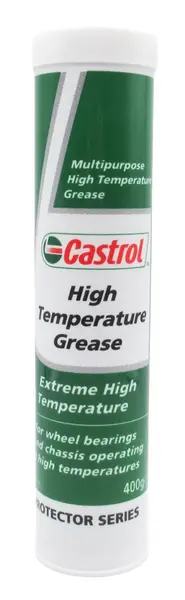 1503AD - Castrol High Temperature Grease 400g
Where the grease nipples are
When looking at the MGA, MGB, MGC, V8 and Midget, their greasing points share a very similar pattern, with four or six nipples to grease on the front suspension, one on the propshaft sliding joint on the MGA and MGB and, for most, one on the handbrake cable. In earlier years the cars’ specifications could also have included a grease nipple on each track rod end joint and on both propshaft universal joints, plus a greasing port on the water pump; however, for almost every car those areas will have been replaced with sealed for life units with the external lubrication option removed.
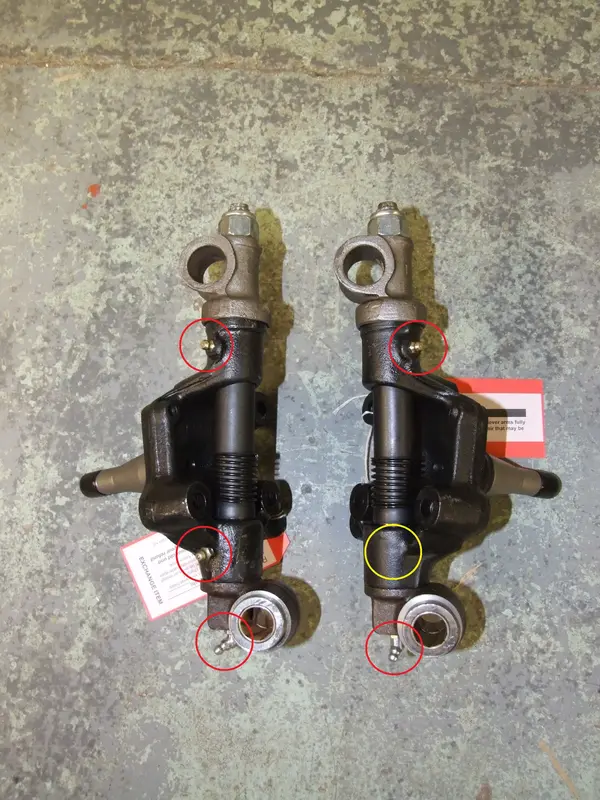 Classic MG front suspensions have several grease nipples; here, MGB kingpins with the six nipple positions shown.
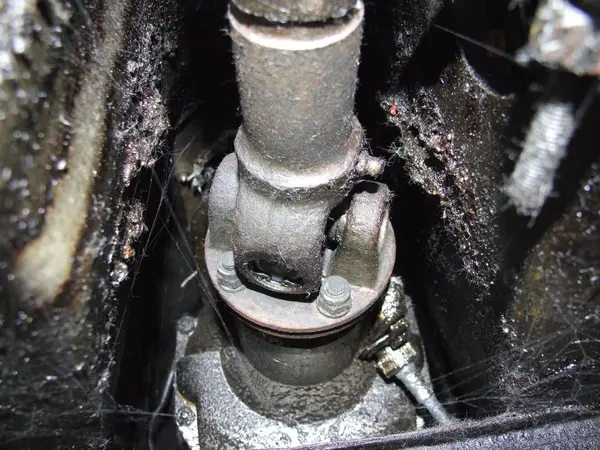 Propshaft front sliding joints are a common area where a grease nipple is found.
Miscellaneous lubrication: linkages, locks and hinges
Many small areas of your car also need a drop of oil during a service, and that includes throttle linkages and all locks (except the steering lock) and hinges. Some early MGB hinges, for example, were made with a specific groove on the top face of the hinge where a few drops of oil can be applied that will then see the oil percolate along the groove into the pivot area of the hinge. As neat as this sounds, it is easy to add too much at any one time and see the oil drip down where it makes a mess, so here a little at a time, left for a period for that oil to move, reduces the chances of ending up with a mess.
Hood frames
An almost unique lubrication point that is often missed is the folding hood frame, which should have a drop of oil, either engine oil or a light oil such as 3-in-1 or even unused SU dashpot oil, on each of the pivot points, and then have the hood moved from the raised to the lowered position several times to encourage the oil to penetrate the pivot. Also be careful not to introduce more than a single drop, otherwise it can drip onto interior trim and can damage this unless any excess is wiped off immediately. This type of oil can be applied to many other areas, including all locks (except the steering lock) and hinges.
The Lucas distributor
Another often forgotten lubrication point is the Lucas distributor, and here the cap and rotor arm have to be removed, then no more than a couple of drops of light oil applied to the visible screw head that is inside the distributor top shaft, before the rotor and cap are refitted. Whilst inside the distributor, some points incorporate an extension fork to the metal base of the points that carries a felt pad that rubs against the distributor cam. This should NOT be given any oil lubrication, as it will be too much and oil will be spread within the distributor and can then degrade the operation of the points. The plastic heel of the points should slide well enough without lubrication or excessive wear of the heel. Finally, very occasionally, lubrication of the mechanical advance components’ pivot points within the distributor may be needed, but that will require the distributor to be lifted out from the engine and the baseplate removed to access the mechanical advance parts.
Rog
Related reading
See our full range of Classic MG Parts here. For further information contact our helpful sales advisors by phone on +44 (0)1954 230 928 or email at sales@mgocspares.co.uk.
Please Note: The information provided in this blog is intended as a general guide only. While we aim to ensure accuracy, classic vehicles can vary, and procedures may differ depending on model and condition. Always consult your vehicle’s official workshop manual before carrying out any work. If in doubt, seek the services of a qualified professional.
© 2025 MGOC Spares Ltd. All rights reserved.
This blog and its contents are the intellectual property of MGOC Spares Ltd and may not be copied, reproduced, or republished without prior written permission.
For author enquiries, corrections, or reproduction requests, please contact: blog@mgocspares.co.uk
Meet Roger Parker – our MG “Tech Guru” with a lifetime of passion for all things MG!
From his early experiences with MGs, to a career as a traffic officer developing ANPR systems, advising MG Rover and then as a technical advisor & writer at the MG Owners’ Club – Roger has worked on hundreds of MGs. Now, in “retirement,” he shares his unrivalled knowledge with us at MGOC Spares.
His blogs (exclusive & free!) are packed with expertise you won’t find anywhere else.
View more here
Who are MGOC Spares?
At MGOC Spares, we provide dedicated parts and accessories for classic MG vehicles, including the MGB, Midget, MGC and many more.
With thousands of products in stock, we are your one-stop shop for all your classic car needs. Our wealth of expertise means that you can trust us to find the right part for your classic MG vehicle – whatever it may be.
Need support finding the right parts for your MG?